You’re looking at a sweater and the product page is full of badges: GOTS, OEKO-TEX, bluesign, GRS. They sound reassuring. But what do they actually tell you about the thing you’re about to buy?
The short version is that clothing certifications each cover one slice of the story. One looks at how much of the fibre is organic. Another tests the finished fabric for harmful chemicals. Another looks at how a brand treats the people in its factories. None of them tells you whether a piece is well made, or “sustainable” overall. This guide explains what GOTS, OEKO-TEX, bluesign, GRS and Fair Wear do and don’t mean, so the next badge you see makes sense.
The short answer: GOTS is about organic fibre and how it is processed. OEKO-TEX STANDARD 100 tests the finished product for harmful substances. bluesign is about managing chemicals and resources in production. GRS is about recycled content. Fair Wear is not a product label at all: it’s an organisation that checks how member brands treat garment workers. Each covers one slice, so one badge never tells you a piece is “sustainable” overall.
Last updated: November 2026. Standards are revised from time to time, so check the certifier’s own site for the current rules. We link each one below.
Jump to: At a glance · GOTS · OEKO-TEX · bluesign · GRS · Fair Wear · What none of them tell you · How to check a label · In our directory
The five labels at a glance
| Label | What it covers | What it does not tell you | Is it a product label? |
|---|---|---|---|
| GOTS | Organic fibre content and how textiles made from it are processed | How long the piece lasts, or the brand's overall footprint | Yes: a label with a grade and a licence number |
| OEKO-TEX STANDARD 100 | The finished product, tested for harmful substances | Whether the fibre is organic or recycled, or how workers are treated | Yes: check the test number against the certificate |
| bluesign | Managing chemicals and resources in textile production | The type of fibre, durability or labour conditions | Both: company partnerships and a separate product certification |
| GRS | Recycled content, plus social and environmental rules in processing | How long the piece lasts, or the full impact of the brand | Yes, on products with at least 50% recycled content |
| Fair Wear | How member brands manage labour standards with garment factories | What the piece is made of, or whether every factory is perfect | No: it is a membership for brands |
GOTS: organic fibre, and how it’s processed
GOTS stands for the Global Organic Textile Standard. It certifies the processing of textile goods made with organic fibres. It doesn’t cover the farming itself: the raw fibre has to be certified to an accepted organic standard before it enters the GOTS chain.
There are two label grades you’ll see:
- Organic: at least 95% certified organic fibres.
- Made with organic materials: at least 70% certified organic fibres. (Older material says “made with organic”.)
Under version 4.0 of the GOTS rules, “100% organic” isn’t allowed as a label grade. GOTS also doesn’t allow a product to blend organic and conventional versions of the same fibre, so an organic cotton shirt can’t contain conventional cotton too.
A proper GOTS label shows the GOTS logo, the grade, the certifier’s details and a licence number. A “made with organic” sweater can still be up to 30% other fibres, so read the percentages and not just the logo.
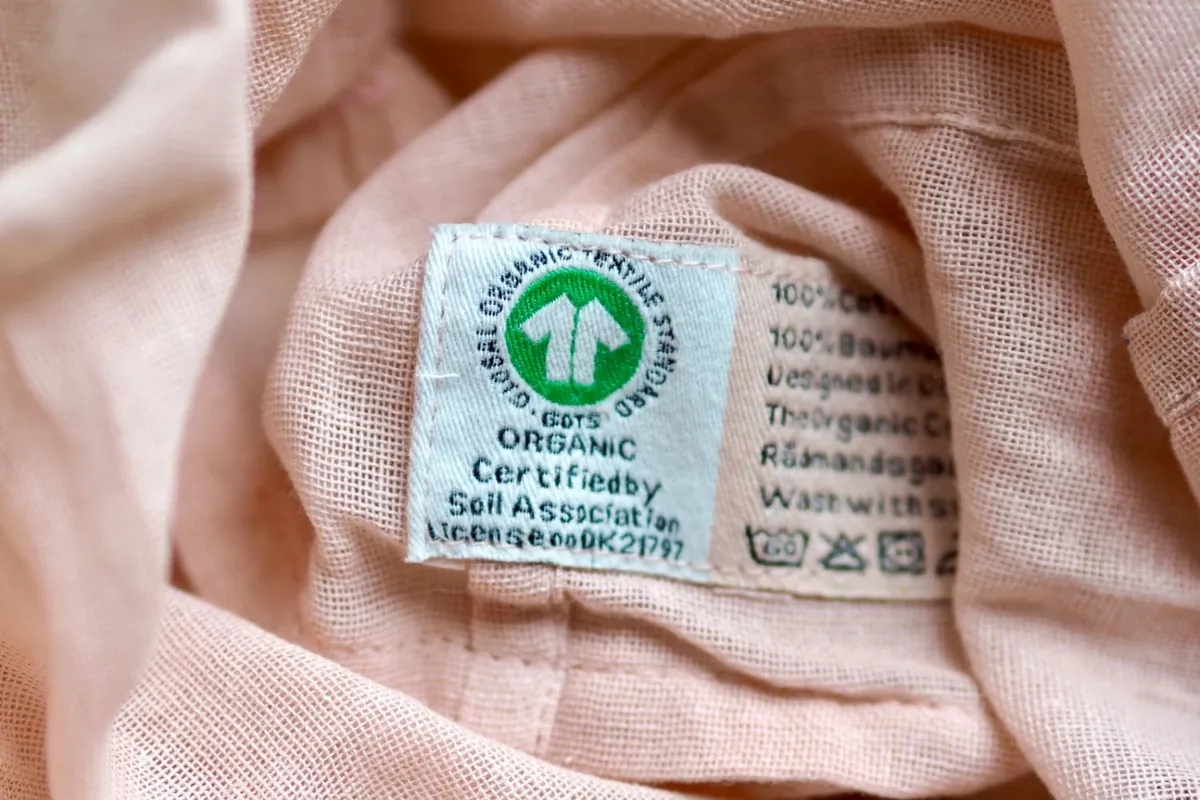
A GOTS label sewn into a garment. This one shows the logo, the grade (Organic), the certifier (Soil Association) and a licence number.
What it doesn’t tell you: how long the piece will last, how well it’s made, or what the brand does beyond this product.
OEKO-TEX STANDARD 100: tested for harmful substances
OEKO-TEX STANDARD 100 tests finished textile products for harmful substances. Its list includes things like certain azo colourants, PFAS, formaldehyde, phthalates and heavy metals such as lead and cadmium. The more a textile touches the skin, the stricter the limits. There are four product classes: babies and children up to 3 years, items with skin contact, items without skin contact, and home textiles.
It covers chemical safety only. A different label, OEKO-TEX MADE IN GREEN, also looks at sustainable and socially responsible manufacturing. So if you see “OEKO-TEX certified” on a product, it tells you the item was tested for harmful substances. It doesn’t tell you the fibre is organic or recycled, or how workers were treated. A sweater can carry the label and still be mostly acrylic.
Be careful with the logo alone. OEKO-TEX says a label on a product isn’t enough proof. The test number and the testing institute on the label should match a valid certificate, and you can check them with the OEKO-TEX Label Check.
bluesign: managing chemicals in production
bluesign describes itself as an independent system for managing chemicals and resources across textile production. The idea is to act early: chemical products are assessed against its criteria before they enter production. Companies that join are called system partners, and bluesign says its assessors visit them at least every three years to review chemical management, resource use, environmental performance, and worker and consumer safety. It lists more than 900 partners worldwide. Most of what we know here comes from bluesign’s own site, so treat it as its self-description.
bluesign also has a separate product certification for finished goods. That’s where it gets confusing. A brand might say it uses “bluesign approved” fabrics. That can mean the fabric maker is a system partner, or that a product is certified. These aren’t the same thing, and a partner brand doesn’t mean every product it sells carries the label. If it matters to you, ask the brand which one it means.
What it doesn’t tell you: whether the fibre is organic or recycled, how durable the piece is, or labour conditions.
GRS: recycled content
GRS is the Global Recycled Standard, run by Textile Exchange. It’s about recycled content, and the production steps behind it.
- The thresholds: a product needs at least 20% recycled input to be certified, but to carry a GRS label or claim aimed at shoppers it needs at least 50%.
- What counts: only pre-consumer and post-consumer materials count as recycled content.
- The supply chain: every stage of production has to be certified, from the recycler to the last seller.
- Social and environmental rules: certified sites have to meet them, and the standard restricts hazardous chemicals in processing. It doesn’t address chemicals that may already be in the recycled material.
Textile Exchange revises its standards, so check the current version before quoting a threshold.
What it doesn’t tell you: how long the piece will last. Recycled content tells you where the material came from, not how well it’s made.
Fair Wear: how brands treat garment workers
Fair Wear is the odd one out. It’s not a label on a product. Fair Wear Foundation is an organisation that brands join. Its Code of Labour Practices sets out eight international labour standards, and Fair Wear publishes a Brand Performance Check for each member, which looks at how the brand’s management systems support those standards.
Members are placed in categories such as Leader, Good and Needs improvement, and most receive Good. In the early years of membership, a brand must monitor a share of its production, and after three years it’s expected to monitor its full supply chain. So a Fair Wear member is a brand that is checked on how it manages labour risks. It doesn’t mean there are no problems.
To check, look at the member directory on the Fair Wear website and read the brand’s published performance check.
What it doesn’t tell you: what the piece is made of, or how it holds up.
What none of these labels tell you
- They each cover one slice. Fibre, chemicals, recycled content or labour. No label covers all of them.
- A logo isn’t proof. Look for a licence number, a test number or a certificate you can check.
- Company and product are different. A company can be certified without every product it sells being covered.
- Percentages matter. 70% organic is not 95%, and a recycled claim needs at least 50% to appear on a label.
- They don’t measure quality. A certified piece can still be poorly made. Our quality checklist shows how to check the piece itself.
- No label doesn’t mean no effort. Some small brands may follow standards without paying for certification. Ask them.
For the bigger picture, see our post on whether European brands are more sustainable.
How to check a label in five minutes
- Work out which slice it covers. Fibre, chemicals, recycled content or labour.
- Find the number. A GOTS licence number, an OEKO-TEX label or test number, or a certificate reference.
- Look it up with the certifier:
- GOTS: the Certified Suppliers database
- OEKO-TEX: the Label Check
- GRS: Textile Exchange’s certificate authentication page
- bluesign: the System Partner list
- Fair Wear: the member directory
- Read the grade or percentage. Is it “organic” or “made with organic”? Is it at least 50% recycled?
- Ask the brand. If the database is silent, ask for the certificate.
One more caveat: these databases can lag by a few weeks, and GOTS notes that its database isn’t definitive proof. If it matters, ask for the scope certificate.
What brands in our directory say
These are statements from brands’ own sites, as recorded in our profiles. We haven’t checked their certificates, and a mention doesn’t mean every product is covered.
- GOTS: Artknit Studios says its organic cotton is OEKO-TEX and GOTS certified. Baum und Pferdgarten says its Napolen jeans carry a GOTS certificate for 98% organic cotton. House of Dagmar says all its denim uses GOTS-certified organic cotton. Nudie Jeans lists a GOTS label on its wool sweater. Samsøe Samsøe cites GOTS, GRS and RWS. Skall Studio says its denim is GOTS-certified organic cotton.
- OEKO-TEX: Artknit Studios says its merino wool and organic cotton are OEKO-TEX certified. Devold says the products we looked at carry OEKO-TEX 100 certificates.
- bluesign: Bergans says many of its products use bluesign approved fabrics.
- GRS: By Malene Birger says it is certified to the Global Recycled Standard (since 2024), though only products carrying the label make the claim. Samsøe Samsøe cites GRS too.
- Fair Wear: TOTEME says it’s a Fair Wear member.
To see how we decide which brands to feature, read How We Choose the Brands We Feature or browse the full directory.
A final thought
Labels can be useful. They give you something you can check, which is more than a vague “eco” claim. But each one answers a narrow question. Next time you see a badge, ask which question it answers, and whether the brand has told you the rest.
Sources and caveats
These are the certifiers’ own pages. Standards change, so check the current rules before relying on a figure.
- GOTS: organic fibres, label grades and identifying GOTS goods
- OEKO-TEX: STANDARD 100 and the Label Check
- bluesign: about bluesign and the System Partner list
- Textile Exchange: GRS and RCS and certificate authentication
- Fair Wear: member brands