Merino and cashmere are the two fibres most people end up choosing between when they buy a good sweater, and the price gap can be real. So the question is whether the extra money buys something you will notice: more warmth, more softness, a longer life. Sometimes, but it depends less on the fibre name than on how the sweater is knitted and looked after.
This guide compares the two on warmth, softness, pilling, care and repair. We use what three makers in our directory say about their own pieces: Artknit Studios in Italy, John Smedley in England and Johnstons of Elgin in Scotland. We checked their US stores for current products and prices on 3 November 2026. We haven’t tested the sweaters ourselves, so where a point is a maker’s claim, we say so.
The short answer: Neither fibre is simply better. A dense, mid-weight merino is the practical pick for a sweater you’ll wear every week: it costs less, and some makers label it machine washable. Cashmere is worth the extra money if you want the softest, lightest warmth and you’re happy to hand wash it, comb it and mend it. Whichever you choose, how well the sweater is knitted and cared for matters more than the fibre name.
Last updated: 3 November 2026. Prices, sizes and stock come from the US stores of the three brands on that day and change often. This is general guidance, not a test of any garment.
Jump to: At a glance · Warmth · Softness · Pilling · Care · Repair · Price · How to choose · What to check · The three makers · Sources
Merino vs cashmere at a glance
Merino is wool from merino sheep. Cashmere is the soft undercoat of cashmere goats, which John Smedley says is collected by combing rather than shearing. Here is how they compare in the sweaters we looked at.
| Merino | Cashmere | |
|---|---|---|
| Warmth | Warm and breathable. Mostly set by how thick and dense the knit is. | Light for its warmth. Also set by ply and weight, from fine 2-ply to heavy 8-ply and 10-ply knits at Johnstons. |
| Softness | Very soft in fine grades, and Woolmark says it can be softer than cashmere. Coarser grades feel firmer. | Often described as silkier. Its fibre fineness overlaps with fine merino. |
| Pilling | Can pill where it rubs. Johnstons says this is natural and not always a sign of poor quality. | Johnstons says a few pills after the first wears are a natural process. Remove them with a comb. |
| Care | Air between wears. John Smedley's Marcus is labelled machine wash at 30°C, but Johnstons says hand wash. Follow the label. | Hand wash, about every three to four wears (Johnstons). Dry flat. Never tumble dry. |
| Repair | Holes and loose seams can be mended. Artknit offers it, in Europe only. | Johnstons points customers to its partner Cashmere Circle for mending and laundry. |
| US price, 3 Nov 2026 | $199 to $435 for the pieces we looked at. | $425 to $454 for the pieces we looked at. Heavier Johnstons cashmere knits cost far more. |
| Our view: best for | Your everyday sweater, layering under a coat, frequent wear. | Your softest layer, lighter warmth, careful or occasional wear. |
Which is warmer, merino or cashmere?
Warmth is mostly about how thick and dense the knit is, so a heavy merino can be warmer than a fine cashmere. Look at the weight and construction before the fibre name.
The three makers show the range. Johnstons of Elgin sells cashmere jumpers in constructions from 2-ply, which it describes as a lightweight feel, up to 6-, 8- and 10-ply knits. Ply is the number of strands twisted together to make the yarn, and a higher count generally means a thicker, warmer knit, although fibre quality and knit density matter too. John Smedley’s Marcus is an Extra Fine Merino jumper that the brand calls lightweight and suited to year-round wear. Artknit describes its Chunky Wool as extra warm and made for lower temperatures.
Makers also lean on what each fibre does well. Johnstons says merino is naturally breathable and regulates temperature, so it stays warm without feeling heavy. John Smedley says cashmere fibres are three times more insulating than sheep’s wool. That is a claim from a maker that sells both fibres, it is about the fibre and not a finished sweater, and we couldn’t check it.
Our view: for a cold commute, choose a heavier knit in either fibre and layer a lighter one underneath. For offices and indoor layering, a fine merino or a 2-ply cashmere is plenty.
Which is softer?
Softness comes down to how fine the fibres are, measured in microns. A lower number means a finer, softer fibre. Woolmark, the wool industry body, says prickle comes from coarse fibre of any type, not from wool itself, and that fine merino can be softer than cashmere. Woolmark promotes merino, so treat that as one side of the argument. The makers’ own figures do show how much the two overlap:
- Artknit Studios: its Extrafine Merino is 19.5 microns and its Ultrasoft Wool is 17.5 microns. Artknit says the Ultrasoft Wool feels similar to cashmere to the touch.
- John Smedley: puts cashmere at around 19 microns and merino at 13 to 22 microns.
Those are the makers’ own figures, and published numbers for both fibres vary by source and by grade, so use them as a guide. The fibre name alone won’t settle it.
Our view: the softest cashmere feels silkier and lighter than most merino, while a fine merino from a good maker can come close. A coarser or lower-grade version of either can feel firm. Hold the sweater against your neck or the inside of your wrist, and if you can’t try it on, check the return window. According to our brand pages, Artknit, John Smedley and Johnstons each allow at least 14 days from delivery to return unworn items, though the conditions differ and some holiday orders get longer.
Does cashmere pill more than merino?
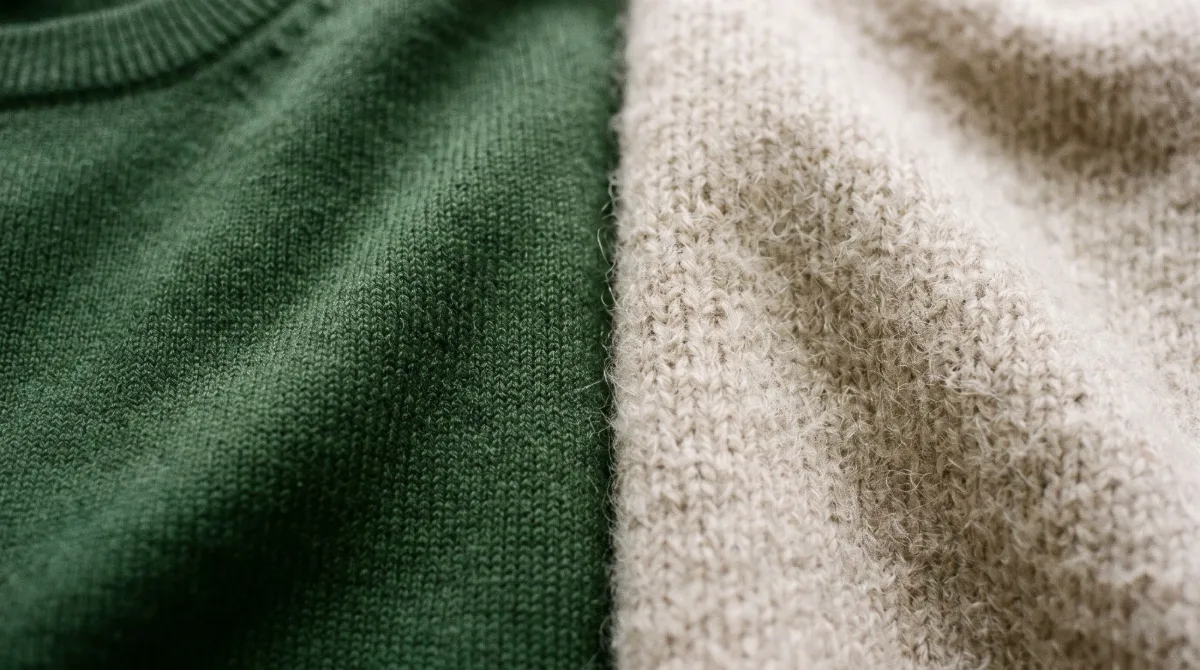
Every knit pills a little. Pills are small balls of loose fibre that form where a sweater rubs against itself or against a bag or a desk, most often at the elbows, underarms and sides. Woolmark says pilling is caused by rubbing during wear, depends on many factors including how active the wearer is, and that nobody can guarantee a garment won’t pill.
Both fibres do it, and the makers say it’s normal. Johnstons says a few pills on cashmere after the first few wears are a natural process. In its merino care guide, it says fine merino fibres can pill through friction and that this doesn’t necessarily indicate poor quality.
What separates a sweater that pills a little from one that sheds constantly is mostly construction. Woolmark’s advice to designers is to use longer fibres, the highest twist factor you can handle and fabrics with a higher cover factor, which means a denser knit. John Smedley says its tension control and finishing help keep pilling at bay, and we haven’t tested that. A softer, more loosely spun yarn can pill sooner, which is our reading of Woolmark’s advice, not a tested result.
What to do about it:
- Lift pills off by hand, with a comb used very gently, or with a battery-powered fabric shaver, all of which Woolmark suggests. Johnstons recommends a cashmere comb. Artknit sells a Pilling Knitwear Comb for $29 on its US store.
- Turn the sweater inside out to wash it, and skip fabric softener, as Woolmark advises.
- If a brand-new sweater is heavily pilled after a few wears, that may point to a weaker yarn. Our quality checklist shows how to test a knit before you buy.
Which is easier to care for?
Merino and cashmere want the same basics: wash less, use cool water, dry flat, fold rather than hang and never tumble dry. Our wool and cashmere care guide covers each step. The differences between the two are small but worth knowing before you buy.
- The label decides, not the fibre. John Smedley’s Marcus merino jumper says machine wash at 30°C with a non-bio detergent, and no tumble dryer. Johnstons of Elgin recommends hand washing its merino in lukewarm water, and says to hand wash cashmere gently after every three to four wears. Artknit says to hand wash its knitwear for ten minutes at 40°C at most, using a wool and cashmere detergent.
- Merino can be aired. Johnstons says merino garments can often be refreshed by hanging them in a well-ventilated space after wear, and Woolmark says wool is naturally stain and odour resistant, so it needs less washing.
- Cashmere is less forgiving. Johnstons says never to tumble dry it and to use a little cashmere shampoo, and its care guide starts with combing off any pills.
Our view: if you don’t want to hand wash, a merino whose label allows a machine wash is a real everyday advantage. Check the label on the exact piece before you rely on it.
Can you repair merino and cashmere sweaters?
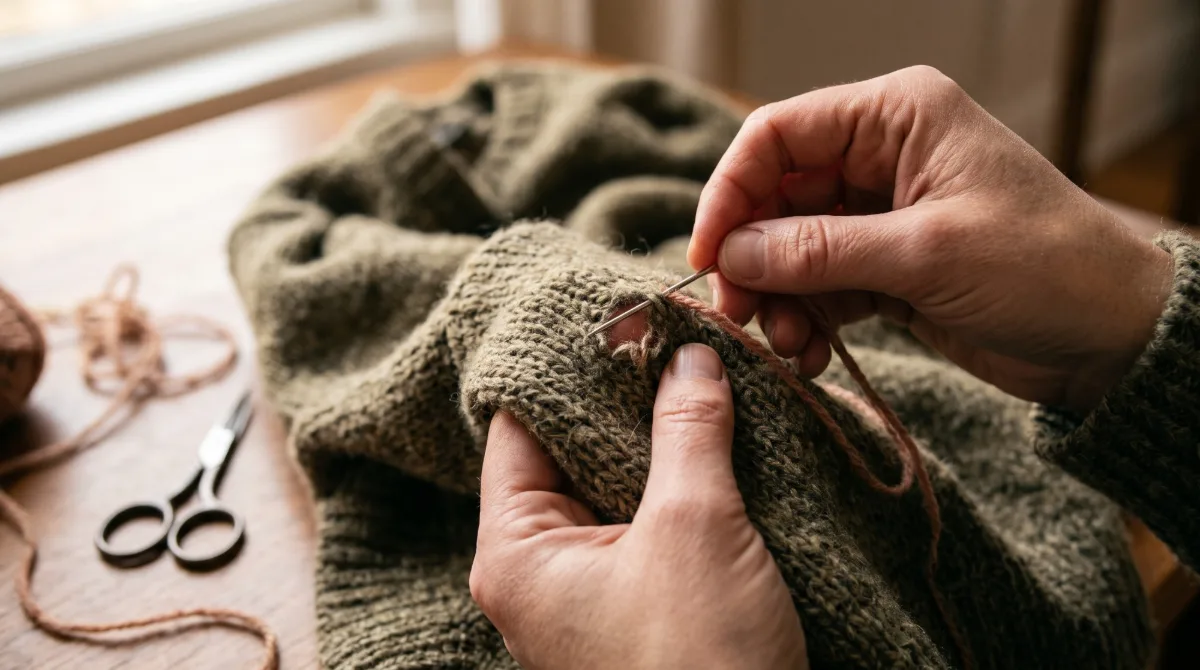
Holes happen, from a jewellery snag, a zip or a moth. A mend is usually far cheaper than a replacement, so it’s worth knowing who will do it before you buy. Here is what the three makers say.
- Artknit Studios runs a Repair Program where its artisans mend holes, pulled threads and signs of wear, and treat pilling and reshape a knit. A request starts with a free consultation, with an answer within 72 hours, and a repaired piece comes back in about 10 to 14 working days. Prices run from 28.90 euros for a single hole or seam in Italy, or 39.90 euros elsewhere in Europe, up to 59.90 euros for a large hole in Europe. Artknit says it repaired more than 100 pieces in 2025. The service is available in Europe only, so US customers can’t use it. Artknit’s US store sells care products and links to repair video tutorials.
- Johnstons of Elgin points customers to its partner Cashmere Circle, which offers invisible mending for small holes and moth damage, cashmere or suede patches for larger ones, and a washing, de-pilling and steaming service. The pages we read don’t give prices, and we couldn’t confirm whether Cashmere Circle takes parcels from the US. Ask before you rely on it.
- John Smedley: we didn’t find a repair service on the US pages we read, and its FAQ doesn’t mention one. If repair matters to you, ask its customer service before you buy.
Our view: a repair service isn’t a reason to buy a fibre, but it does change the sums on a pricey sweater. If a maker’s service doesn’t reach you, a local tailor or invisible mender can handle small holes, and mending early keeps them small. See the care guide for mending tips.
Is cashmere worth the extra cost?
Here are current US prices for six sweaters from the three makers, with the cost per wear if you wear each one 150 times (30 wears a winter for five winters). That count is an illustration, not a prediction. Our cost per wear guide has a calculator for your own numbers.
| Sweater | What it's made of | US price, 3 Nov 2026 | Per wear over 150 wears |
|---|---|---|---|
| Johnstons of Elgin, Grey Superfine Merino Round Neck Jumper (women's) | 100% merino wool | $199 | $1.33 |
| Artknit Studios, The Ultrasoft Wool Roll-Neck | Sold as 100% merino wool, 17.5 microns (per Artknit) | $329 | $2.19 |
| Artknit Studios, The Merino Wool Boxy Sweater | 100% merino wool, 19.5 microns (per Artknit) | $359 | $2.39 |
| Johnstons of Elgin, Black Cashmere Round Neck Jumper (women's) | 100% cashmere, 2-ply, made in Scotland | $425 | $2.83 |
| John Smedley, Marcus Jumper | Extra Fine Merino, made in England | $435 | $2.90 |
| Artknit Studios, The ReCashmere Ribbed Sweater | ReCashmere yarn: 35% virgin and 65% regenerated cashmere fibres (per Artknit) | $454, listed down from $649; only size L left | $3.03 |
Read the table with two cautions. Sizes and stock change fast: on the day we looked, three of these six were down to one or two sizes. And prices differ by market, so check the store set to the US. The Artknit merino sweater, for example, was shown at 209 euros on sale in Italy against a 359 euro “traditional retail price”, while the US store listed it at $359 with no struck-through original price.
The useful finding is how small the gap is once you spread it over many wears. The Johnstons cashmere costs $226 more than its women’s superfine merino round neck, about $1.51 a wear over 150 wears. The Artknit ReCashmere costs $95 more than its merino, about 63 cents. What costs more is a sweater you don’t wear: a $425 cashmere sweater worn 40 times comes to about $10.63 a wear, while a $199 merino worn 150 times comes to about $1.33. That is the heart of buying fewer, better things: pick the sweater you’ll reach for most, not the one with the grandest fibre.
How to choose: merino, cashmere or a blend
Choose merino if:
- you’ll wear it every week, or it’s your main sweater of the winter
- you want a lower price, or a label that allows machine washing
- you like a springy, structured knit that layers under a coat
Choose cashmere if:
- softness against the skin is your priority
- you want light warmth without bulk
- you’ll wear it less often, or as your best sweater, and are happy to hand wash, comb and mend it
Consider a blend or recycled cashmere if you want some of cashmere’s softness with more durability. John Smedley makes an Eco Cashmere of 50% recycled cashmere and 50% Extra Fine Merino, and says the pairing keeps the softness of pure cashmere while improving durability. Artknit’s ReCashmere is another route, with the yarn made from 35% virgin and 65% regenerated fibres. We haven’t tested the durability of either.
Be careful with very cheap “cashmere.” Cashmere is scarce, and John Smedley notes that each goat yields only a limited amount of raw fibre. A very low price on a 100% cashmere sweater deserves a closer look at the label and the knit.
What to check before you buy
- The fibre content. Look for the full composition on the label. “100% merino wool” or “100% cashmere” is clear. Words like “cashmere feel” are not.
- The fineness or grade. Artknit states its micron figures. John Smedley sells Extra Fine Merino, and Johnstons lists superfine merino. A stated figure or grade is better than none.
- The ply, gauge or weight. Johnstons lists ply on its cashmere. A heavier, denser knit is generally warmer and tougher.
- The knit itself. Hold it up to the light, stretch a cuff and check the seams. Our quality checklist covers each test.
- Care and repair. Read the care label, and ask whether the maker repairs its pieces in your country.
- The return window. Softness and fit are personal, so check that you can send it back.
Artknit, John Smedley and Johnstons: what we found
We checked each brand’s US store on 3 November 2026. These are summaries; each brand page has more on shipping, duties and returns for US orders.
Artknit Studios (Italy). Its motto is “Buy Less, Buy Better”, and it publishes the micron figures for its wool. We looked at The Merino Wool Boxy Sweater ($359, 100% merino, sizes XS to XL in stock), The Ultrasoft Wool Roll-Neck ($329) and the archive ReCashmere pieces ($454). One caution: Artknit describes the ReCashmere yarn as 35% virgin and 65% regenerated fibres, yet some product blurbs say “100% recycled cashmere”, so read the material section on the product page. The Repair Program is for Europe only.
John Smedley (England). The Marcus Jumper is $435 in Extra Fine Merino, an easy fit in 18 colours. John Smedley says it is made at Lea Mills in Derbyshire, with the merino sourced through ZENTERA from ZQ+ regenerative farms in New Zealand and spun in Italy. The brand also sells cashmere, which it says comes from small herders in the Alashan Mountains of Mongolia. We found no repair service on its US pages.
Johnstons of Elgin (Scotland). It sells both fibres side by side, which makes it the easiest to compare: the women’s Grey Superfine Merino Round Neck Jumper at $199 and the Black Cashmere Round Neck Jumper at $425, both 100% fibre and both round neck, with the cashmere in 2-ply. A men’s 3-ply merino round neck is $295. Many of its pieces were down to a size or two on the day we looked, and several carried sale or clearance tags. Its repair route is the Cashmere Circle partnership.
A final thought
Merino or cashmere is a smaller decision than it looks. A dense, well-made sweater that you wear twice a week and look after will beat an impressive one that stays in the drawer. Choose the fibre that suits how you live, check the knit and the care label, and then take care of it.
When you’re ready to look, browse our European brand directory.
Sources and caveats
Prices, sizes and stock were checked on the brands’ US stores on 3 November 2026 and change often. Fibre figures are the makers’ own. Where we say “our view”, it is our reading of the sources, not a test result.
- Woolmark: why is merino wool so soft and what is pilling
- Artknit Studios: materials, the Repair Program, the knitwear care guide, The Merino Wool Boxy Sweater and The ReCashmere Ribbed Sweater
- John Smedley: Marcus Jumper, What is cashmere? and Why quality matters
- Johnstons of Elgin: caring for cashmere, caring for merino wool and Cashmere Circle partnership